Monday, December 10, 2018

The Family of God


1 Nephi 1: 7-8


      "And it came to pass that he returned to his own house at Jerusalem; and he cast himself upon his bed, being overcome with the Spirit and the things which he had seen.  And being thus overcome with the Spirit, he was carried away in a vision, even that he saw the heavens open, and he thought he saw God sitting upon his throne, surrounded with numberless concourses of angels in the attitude of singing and praising their God."

Following what we believe to be an event where the Lord appeared to Lehi, Lehi was physically weak.  He didn't just go home and go to bed.  He cast himself upon his bed.  This would appear like complete exhaustion.

Is this something that is to be expected?

Alma chapters 18 and 19 hold the account of Ammon teaching king Lamoni.  In these two chapters Lamoni and his wife and Ammon and the servants of Lamoni all had their physical frames overcome by the power of the Spirit just as happened to Lehi.

Alma chapter 22 contains the account of Aaron, the brother of Ammon, teaching the father of king Lamoni.  Here again we see also the father of Lamoni being overcome physically by the power of the Spirit.

Alma chapter 27: 16 - 18 describes another event where Ammon was overcome physically.


This is what Moses experienced after encountering God on the mount.

     "And the presence of God withdrew from Moses, that his glory was not upon Moses; and Moses was left unto himself.  And as he was left unto himself, he fell unto the earth.  And it came to pass that it was for the space of many hours before Moses did again receive his natural strength like unto man;..." (Moses 1:9-10)

Joseph also experienced the same with the first vision.

     "...When I came to myself again, I found myself lying on my back, looking up into heaven.  When the light had departed, I had no strength; but soon recovering to some degree, I went home..." (Joseph Smith History verse 20)

Being in the Spirit, Lehi is shown the heavens opening and he ascends to the Throne of the Father where there are numberless concourses of angels singing and praising God.

Something we think ought to be seriously considered is that his experience is not the only recorded experience of a mortal ascending to the Throne of the Father or seeing the Father.

     "...In the year that King Uzziah died, I saw the Lord sitting upon a throne, high and lifted up, and his train filled the temple." (2 Nephi 16: 1)

Alma the younger also saw the same sight.

     "Yea, methought I saw, even as our father Lehi saw, God sitting upon his throne, surrounded with numberless concourses of angels, in the attitude of singing and praising their God; yea, and my soul did long to be there." (Alma 36: 22)

This is what the prophet Joseph recorded in one of his accounts of his first vision.

     "A pillar of fire appeared above my head.  It presently rested down upon me and filled me with joy unspeakable.  A personage appeared in the midst of this pillar of flame, which was spread all around and yet nothing consumed.  Another personage soon appeared, like unto the first.  He said unto me, "Thy sins are forgiven thee."  He testified unto me that Jesus Christ is the son of God.  And I saw many angels in this vision." (Joseph Smith Papers, Journal, 9-11 November 1835)

In these four events, just like Lehi's, there are "many", "numberless concourses", and a "train" of angels that "filled the temple" who are there with the Father.

It seems that Christ can and does appear to individuals; alone and hiding His glory as the scriptures demonstrate.  

When we read of the Father appearing though, or of someone ascending to His Throne, there are always concourses of attending angels.  A numberless train of associates so to speak.

Why would this be?

Why is it so important that the scriptures are so very clear to describe this?

During the Last Supper the Lord told those with Him something important.

     "In my Father's house are many mansions: if it were not so, I would have told you.  I go to prepare a place for you.  And if I go and prepare a place for you, I will come again, and receive you unto myself; that where I am, there ye may be also." (John 14:2 -3)

Was the Lord referring to a physical house with doors and windows?  

Was He speaking metaphorically?

We believe He was speaking metaphorically.

The term "house" is used to describe a family, ie. "the House of Windsor".

We are invited to refer to God as our "Father" in heaven.

Of all the titles He could have us address Him with He chooses "Father."

He has a "house", "the House of God", His family. His family is His kingdom.

Joseph described the Family or Kingdom of God.
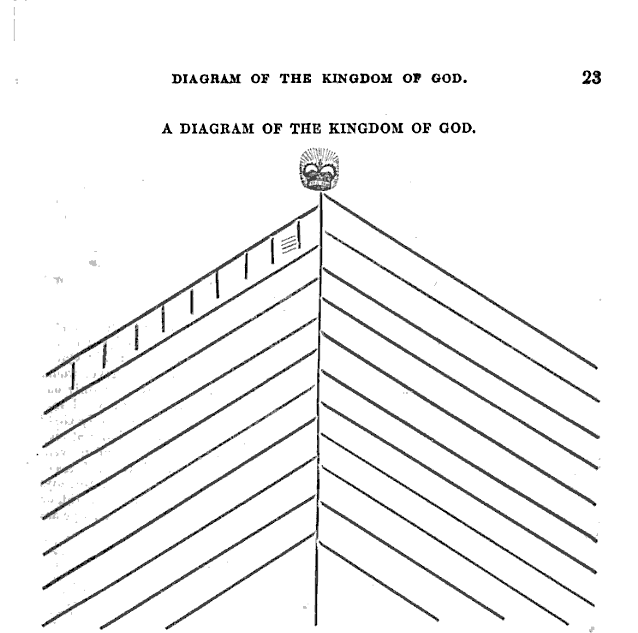


To understand this let's look at Adam and Eve.

     "...And he heard a voice out of heaven, saying: Thou art baptized with fire, and with the Holy Ghost.  This is the record of the Father, and the Son, from henceforth and forever; And thou art after the order of him who is without beginning of days or end of years, from all eternity to all eternity.  Behold, thou art one in me, a son of God; and thus may all become my sons. Amen." (Moses 6:67 - 68)

A voice out of the heavens declared that Adam had become a son of God. Because Eve is also a part of this with Adam we consider that at this time she became a daughter of God.

Christ declared at this moment that Adam had become "one" with Him.  Adam was now connected to Him.

Adam was the first man in this creation to come up to this order or connection with Christ.  He became a Patriarch, a Father of Many Nations, a Preacher of Righteousness, a Father.  

Since the scriptures state that Adam and Eve together made all things known unto their children we consider that Eve was included in this.  

In fact we believe that because the scriptures state that they were to become one flesh or in other words to become one that the titles above necessarily included her as well.

All who were redeemed by Christ through the ministry of Adam and Eve became their children in the family of God.  

Their children became connected to Christ through them.  Their hearts were turned to their children, those who accepted the Gospel through their ministry. 

The book of Moses sadly recounts that most did not desire this relationship.

We can understand this relationship from the account of Abraham who, along with Sarah, came up to this same order.

This is what the Lord declared to Abraham.

     "My name is Jehovah, and I know the end from the beginning; therefore my hand shall be over thee.  And I will make of thee a great nation, and I will bless thee above measure, and make thy name great among all nations, and thou shalt be a blessing unto thy seed after thee, that in their hands they shall bear this ministry and Priesthood unto all nations;  And I will bless them through thy name; for as many as receive this Gospel shall be called after thy name, and shall be accounted they seed, and shall rise up and bless thee, as their father;" (Abraham 2:8-10)

Adam was the first Father; followed by Seth, etc. to Noah.  Then the family descended from Noah to Shem or Melchizedek and then to Abraham.

All individuals who came up to "this Gospel", all who were and are redeemed through Christ because of their ministries, become connected to them who are connected to Christ who is connected to the Father; thus making up the "family", "kingdom", or "house" of God.

All who come to "this Gospel" become sons of God and joint heirs with Christ.

We submit that those numberless concourses of angels, the train of God filling the temple, are the family of God.  

When someone is brought to the throne of God or into God's presence they are introduced to the "family" because they are becoming part of the family.

You can see from the diagram that there are many "mansions" or temporary dwelling places in the "house" or family of God as one continues to ascend eternally as part of God's family.

We believe that the many "mansions" refers to the many familial connections in the family of God and the ability through those connections to have "seed" through performing a ministry.

As an aside for this post, Joseph stated something critical concerning this family of God in section 128 of the Doctrine and Covenants.

     "...for Malachi says, last chapter, verses 5th and 6th: Behold, I will send you Elijah the prophet before the coming of the great and dreadful day of the Lord: and he shall turn the hearts of the fathers to the children, and the heart of the children to their fathers, lest I come and smite the earth with a curse....It is sufficient to know, in this case, that the earth will be smitten with a curse unless there is a welding link of some kind or other between the fathers and the children upon some subject or other---and behold what is that subject?  It is the baptism for the dead.  For we without them cannot be made perfect. Neither can they without us be made perfect. Neither can they nor we be made perfect without those who have died in the gospel also;"

When Malachi talks of Elijah coming to turn the hearts of the "fathers" to the "children" and the "children" to their "fathers" could he be referring to what was declared to Abraham about all those who received "this Gospel" becoming his children or his seed?

 Who is Joseph referring to as he states that there must be a welding link of some kind between the "fathers" and the "children"?

Who are the fathers? 

Are they the ones who "died in the gospel"? 

Remember the Lord declared to Abraham something concerning "this Gospel." Abraham was part of "this Gospel" and remained so until he died.

Are they the ones who like Abraham back through Adam rose up and became one with Christ, sons of God?

Why does Joseph so clearly distinguish between "we" the "dead" who we could be baptized for and "those who have died in the gospel"?

What does "this Gospel" mean?  

What is it referring to?

When we read of what Adam and those other fathers through Abraham had to receive from heaven in order to enter into the family of God should we expect that we can be part of God's family by receiving anything less than they did?

Is what they received to be interpreted as the description of "this Gospel" that the Lord declared to Abraham?"

If we do not receive "this Gospel" will we be smitten when the Lord returns?

Is the Lord waiting for some group, no matter how small in number, to receive "this Gospel" and therefore have their hearts turned to the original "Fathers", becoming "children" of those "Fathers" before He returns so that the entirety of humanity is not destroyed or smitten at His coming?

Back to the post.

We believe that Lehi is following the pattern that all who would be one with Christ, who would become part of the family of God, must follow.  

He has repented and exercised faith and worked good works until he becomes an individual who can see Christ as He is, because he has acquired the attributes of Christ.  Christ then comes to him and prepares him to meet the Father (appearing in a pillar of fire dwelling on a rock).

     "Jesus saith unto him, I am the way, the truth, and the life: no man cometh unto the Father, but by me." (John 14:6)

Christ Himself declared that no man would come to the Father before He, Christ, prepared them.

Nephi declared,

     "Behold, this is the doctrine of Christ, and there will be no more doctrine given util after he shall manifest himself unto you in the flesh.  And when he shall manifest himself unto you in the flesh, the things which he shall say unto you shall ye observe to do." (2 Nephi 32: 6)

We believe that the reason Nephi declared this is that by experience Nephi knows that, just like his father Lehi, the Lord appears to any mortal ("in the flesh")who arrives at the same situation as Lehi in order to prepare them to be introduced to the Father.

Christ personally instructs and guides those who have become like Him in order to prepare them to enter the Father's presence.

Lehi is then introduced to the Father and the rest of the family of God, the numberless concourses of angels. He is made a son of God and a joint heir with Christ by the Father's own voice.

We believe that this event with Lehi is a description of "this Gospel."

Is it possible that this is the moment, for anyone who ascends to God, that they receive the testimony of Jesus; ie. Jesus bears testimony of them to the Father that they are redeemed and made holy through Him in order to be made a part of the family of God?

This is what D&C 76 says concerning those who enter into the celestial kingdom.

     "They are they who received the testimony of Jesus...These are they who have come to an innumerable company of angels, (think numberless concourses of angels) " (D&C 76:51-67) 

We believe this is what is occuring to Lehi at this moment.

Lots to think about.


Sunday, December 2, 2018

A Pillar of Fire Dwelling on a Rock

1 Nephi 1:6


     "And it came to pass as he prayed unto the Lord, there came a pillar of fire and dwelt upon a rock before him; and he saw and heard much; and because of the things which he saw and heard he did quake and tremble exceedingly."

As a group we are curious about the symbolism represented in this event.

We believe that Lehi saw the Lord at this time but we are curious as to why this symbolism is used. 

Why doesn't the record simple state that the Lord appeared to Lehi?  

What is the importance of the symbolism?

This event is reminiscent of the experience with Moses.

     "Now Moses kept the flock of Jethro his father in law, the priest of Midian: and he led the flock to the backside of the desert, and came to the mountain of God, even to Horeb.  And the presence of the Lord appeared unto him in a flame of fire out of the midst of a bush: and he looked, and, behold, the bush burned with fire, and the bush was not consumed.  And Moses said, I will now turn aside, and see this great sight, why the bush is not burnt.(JST Exodus 3: 1-3)

The Lord appeared unto Moses in a bush, giving a sign.  Consider the lighted branches of the bush stretching out like a menorah with it's several lit branches representing the tree of life or the family of God.

The original menorahs had six branches and a center candle.  John referred to it as a symbol of Christ in the book Revelation.

     "I was in the Spirit on the Lord's day, and heard behind me a great voice, as of a trumpet, Saying, I am Alpha and Omega, the first and the last: and, What thou seest, write in a book, and send it unto the seven churches...And I turned to see the voice that spake with me.  And being turned, I saw seven golden candlesticks; And in the midst of the seven candlesticks one like unto the Son of man,..." (Revelation 1:10 - 13)

When the children of Israel left Egypt they had a pillar of fire before them representing the Lord.

Lehi, being a devout man, would have knowledge of Moses' and the children of Israel's experiences and therefore would recognize the presence of the divine before him.

Hugh Nibley described the symbol of the pillar of fire resting on a rock.

     "The stone of Truth (Maat) in our text is necessarily a shining stone, for "Maat seems to signify 'reality' on one hand, and 'light' on the other...Light created all reality.  Maat... is this reality" (Moret, Culte, p. 150).  The prehistoric symbol of Maat is the Maat-stone, shaped like a chisel, that being the hieroglyph with which her name is written; the stone was cut in a special way and mounted in the walls of the oldest temples to direct the rays of the sun for ritual purposes.  Thus as Prof. Westendorf now informs us, Maat is before all else the conveyer of light, especially the sun's light, to men in holy places (W Westendorf, ZA, 97:143ff).  Theophrastus tells us that the King of Egypt received a huge smaragon from the King of Babylon,and that such a gem was set "in the obelisk of Zeus," i.e., the Sun-stone or Benben at Heliopolis, the prehistoric center of solar worship in Egypt (De Lapid., 4, III, 29).  The Egyptians who saw in luminosity the very essence of divinity strove to achieve miraculous lighting effects in ritual, covering sacred images with "efflourescent salt of unusual composition" to make them shine (Lucas, in An. Serv., 17:86-88), and making use of luminescent stones that would shine for a while in the dark after being exposed to sunlight (Pliny, Nat. Hist.., XXXVI, 7, 58). (Nibley, Hugh. The Message of the Joseph Smith Papyri: An Egyptian Endowment. Salt Lake City: Deseret Book, 1975, p.122)

Is the symbol meant to draw our minds to an understanding that the Lord is the Light and the Reality of the world; meaning that all things were created by Him and all things are upheld by Him?

Lehi would have understood this symbolism as representing the divine because of his exposure to Egyptian culture which we discussed in a previous post.

We also have the Lord Himself declaring that He is the rock.

     "I am Messiah, the King of Zion, the Rock of Heaven, which is broad as eternity; whoso cometh in at the gate and climbeth up by me shall never fall;..." (Moses 7: 53)

Here, before Lehi, we have a representation of the Lord as the firm foundation which is reality and light. He created all things and upholds all things. If we establish ourselves upon Him then we will never fall and we will be filled with light.


We believe that it is because of Lehi crying unto the Lord for his people that the Lord showed Himself to Lehi precisely because Lehi through his own actions came to the point where he was able to see the Lord as He is because Lehi was now like Him, a "type" of the Lord. He possessed the charity that Mormon was talking about and he was acting as a "type" by seeking to intercede for his people. He is entering in at the gate.

     "...the keeper of the gate is the Holy One of Israel; and he employeth no servant there; and there is none other way save it be by the gate; for he cannot be deceived, for the Lord God is his name." (2 Nephi 9:41)

The record draws a curtain over the details of what Lehi saw at this time . All that we are told is that he, "saw and heard much."

Why are we left not knowing what was communicated?

Are we not allowed to know what went on?

Can we find out what was communicated?

Is it possible that verses like this in the scriptures are an invitation to us to look into things further?

This is reminiscent of what the Prophet Joseph stated concerning heavenly things that both he and Sidney Rigdon had seen in vision.

     "But great and marvelous are the works of the Lord, and the mysteries of his kingdom which he showed unto us, which surpass all understanding in glory, and in might, and in dominion; which he commanded us we should not write while we were yet in the Spirit, and are not lawful for man to utter; Neither is man capable to make them known, for they are only to be seen and understood by the power of the Holy Spirit, which God bestows on those who love him, and purify themselves before him; To whom he grants this privilege of seeing and knowing for themselves;..." (D&C 76:114 - 117)

We found this similar to what Paul taught to the Corinthians.

     "But we speak the wisdom of God in a mystery, even the hidden wisdom, which God ordained before the world unto our glory:  Which none of the princes of this world knew; for had they known it, they would not have crucified the Lord of glory.  But as it is written, Eye hath not seen, nor ear heard, neither have entered into the heart of man, the things which God hath prepared for them that love him.  but god hath revealed them unto us by his Spirit: for the Spirit searcheth all things, yea, the deep things of God.  For what man knoweth the things of man, save the spirit of man which is in him? even so the things of God knoweth no man, but the Spirit of God.  Now we have received, not the spirit of the world, but the spirit which is of God; that we might know the things that are freely given to us of God.  Which things also we speak, not in the words which man's wisdom teacheth, but which the Holy Ghost teacheth; comparing spiritual things with spiritual.  But the natural man receiveth not the things of the Spirit of God: for they are foolishness unto him: neither can he know them, because they are spiritually discerned." (1 Corinthians 2:7 - 14)

From what both the Apostle Paul and the Prophet Joseph taught we believe that when we see events described in the Book of Mormon like this one with Lehi, where a lot is left untold, that it is an invitation to us to purify ourselves before God and ask to be taught those things that eye hath not seen nor ear heard nor have yet entered into our hearts.  

If God is both unchangeable and is no respecter of persons, which we believe both attributes to be true, then if we qualify, like Lehi or Paul or Joseph or anyone else, God will manifest the same mysteries of His kingdom which surpass all understanding in glory, and in might and in dominion to us.  

We believe that these things cannot be taught one mortal to another. Joseph declared that these things, "are not lawful for man to utter; Neither is man capable to make them known, for they are only to be seen and understood by the power of the Holy Spirit,..."
And Paul declared, "...the things of God knoweth no man, but the Spirit of God."

According to the Prophet Joseph it is necessary for us to come to an understanding of these things here and now if we are going to be able to dwell in the presence of God.

     "That through the power and manifestation of the Spirit, while in the flesh, (here and now) they may be able to bear his presence in the world of glory." (D&C 76: 118)

So, in our minds, we have in verse 6 of the first chapter in the Book of Mormon the presentation of a symbol of the Lord, letting us know that it is Him (light and reality) here with Lehi, immediately followed by His invitation to "come and see" (John 1:39) for ourselves what is going on.

Friday, November 23, 2018

With all His Heart (conclusion)

1 Nephi 1:5


"Wherefore it came to pass that my father, Lehi, as he went forth prayed unto the Lord, yea, even with all his heart, in behalf of his people."

In our little study group we discussed what the prophet Mormon spoke of in the book of Moroni. The prophet Mormon speaks of the attributes expressed in the Sermon on the Mount and the Sermon at Bountiful as charity.

    "And charity suffereth long, and is kind, and envieth not, and is not puffed up, seeketh not her own, is not easily provoked, thinketh no evil, and rejoiceth not in iniquity but rejoiceth in truth, beareth all things, believeth all things, endureth all things." (Moroni 7: 45)

If someone is merciful are they willing to suffer long with others?

If someone is meek are they puffed up?  Would they ever seek their own will?

If someone is a peacemaker can it be said of them that they are not easily provoked and that they are kind?

The Lord said that we should not allow anger to even exist in our hearts. If we follow that course are we in a state where we think no evil?

If we watch all of our thoughts as the Lord exhorted and take up our cross then are we avoiding envy and rejoicing not in iniquity?

If we allow others to exact unjust claims upon us and resist them not, if we pray for them who despitefully use us and persecute us, if we love our enemies, and if we are willing to suffer abuse for the Lord's name can it be said of us that we are willing to bear all things and endure all things?

Can it be reasonably said that a person who lives these principles rejoices in truth and believes all things the Lord declares?

Remember, because this is important, what the Lord declared concerning those who would live this way that they would be "...the children of your Father who is in heaven..." (3 Nephi 12: 45)

Mormon continued and said some very important things about the acquisition of this charity.

     "Wherefore, my beloved brethren, pray unto the Father with all the energy of heart, that ye may be filled with this love, which he hath bestowed upon all who are true followers of his Son, Jesus Christ; that ye may become the sons of God; that when he shall appear we shall be like him, for we shall see him as he is; that we may have this hope; that we may be purified even as he is pure. Amen" (Moroni 7: 48)

According to Mormon, can we develop this attribute in ourselves?


Who does the Father bestow this attribute on?

How does one qualify to be a true follower of God's Son?

What is the relationship to the Father of those who receive this attribute from the Father? (remember what Christ declared about those willing to live the principles of the Sermon on the Mount and at Bountiful)

What does it mean to become sons of God or children of your Father who is in heaven?

Would Christ appear unto someone who is unlike Him? 

Would Christ appear to someone who, like Himself, has become a son or daughter of God?

If a true follower of Christ has this attribute bestowed upon them, and they become like Christ, do they then have a lively hope that He will appear to them?

How does this charity purify those who have it bestowed upon them like Christ is purified when no one is capable of living a perfect sin free life like the Savior did?

We interpret what Mormon spoke, "... that when he shall appear we shall be like him, for we shall see him as he is..." to mean that the reason Christ appears to someone who possesses charity (someone who is living the Sermon on the Mount) is because they are like Him.  They are able to see Him as He truly is.  They understand His character because they are living it. To a certain degree, they truly understand His infinite feelings for all of the Father's children.  They can be trusted with what He has to give to them.

Whatever the Lord imparts to them, whatever He assigns them to do, they will not consume what they receive upon their lusts.  They are in a state where they desire to do the will of the Lord just like the Lord desired to do the will of the Father.

In the book of Helaman chapters 7-9 we can read about one of the individuals, Nephi son of Helaman, who is one of the examples we cited, of an individual who sought to intercede for his people.

He is an individual who possesses the charity Mormon is talking about.

At the very beginning of chapter 7 we read the following concerning Nephi son of Helaman.

     "...therefore, Nephi had bowed himself upon the tower which was in his garden, which tower was also near unto the garden gate by which led the highway.  And it came to pass that there were certain men passing by and saw Nephi as he was pouring out his soul unto God upon the tower; and they ran and told the people what they had seen, and the people came together in multitudes that they might know the cause of so great mourning for the wickedness of the people.  and now when Nephi arose he beheld the multitudes of people who had gathered together.  And it came to pass that he opened his mouth and said unto them: Behold why have ye gathered yourselves together?  That I may tell you of your iniquities?  Yea, because I have got upon my tower that I might pour out my soul unto my God, because of the exceeding sorrow of my heart, which is because of your iniquities!  And because of my mourning and lamentation ye have gathered yourselves together, and do marvel: yea, and ye have great need to marvel; yea, ye ought to marvel because ye are given away that the devil has got so great hold upon your hearts." (Helaman 7:10-15)

Nephi is sorrowing over the wickedness of his people.  He is pouring out his soul to God because of their wickedness.  He yearns for them to have soft hearts and he deeply desires that they would see that the devil has got a great hold upon their hearts.

Is there any judgement in Nephi's feelings?

Does Nephi express any condemnation for them?

Is Nephi willing to suffer long for these folks?  Does he feel mercy for them?

Is Nephi showing forth fruit of one who would be a "type" of Christ who he professed to follow?

From this point in the account to chapter 10 the account describes how Nephi preached repentance and how many of those listening sought to incite the people against Nephi to try to imprison or kill him.  We read of the power of the Lord in revealing to Nephi concerning a conspiracy and a murder and how the Lord revealed the culprit to Nephi.

During this event Nephi's life was on the line just like it was while he was imprisoned with his brother Lehi as described in chapter 5 of Helaman.

How is it that Nephi is able to be so fearless? 

Does Nephi fear to die? 

Does Nephi fear to lose his reputation or standing among the people?

Is Nephi doing his own will or seeking his own in any of this?

In chapter 10 of Helaman we read of a very important experience that takes place with Nephi.

     "And it came to pass as he was thus pondering--being much cast down because of the wickedness of the people of the Nephites, their secret works of darkness, and their murderings, and their pluncerings, and all manner of iniquities--and it came to pass as he was thus pondering in his heart, behold, a voice came unto him saying:  Blessed art thou, Nephi, for these things which thou hast done; for I have beheld how thou hast with unwearyingness declared the word, which I have given unto thee, unto this people.  And thou hast not feared them, and hast not sought thine own life, but hast sought my will, and to keep my commandments." (Helaman 10: 3-4)

Remember in the second part of this discussion how we talked about Christ being the "Word of God" because He fulfilled the will of the Father so perfectly that to view His life was to view God's words or will in perfect action?

Is Nephi seeking to follow the same path?

The Lord continued.

     "And now, because thou hast done this with such unwearyingness, behold, I will bless thee forever; and I will make thee mighty in word and in deed, in faith and in works; yea, even that all things shall be done unto thee according to thy word, for thou shalt not ask that which is contrary to my will.  Behold, thou art Nephi, and I am God. Behold, I declare it unto thee in the presence of mine angels, that ye shall have power over this people, and shall smite the earth with famine, and with pestilence, and destruction, according to the wickedness of this people.  Behold, I give unto you power, that whatsoever ye shall seal on earth shall be sealed in heaven; and whatsoever ye shall loose on earth shall be loosed in heaven; and thus shall ye have power among this people.  And thus, if ye shall say unto this temple it shall be rent in twain, it shall be done.  And if ye shall say unto this mountain, Be thou cast down and become smooth, it shall be done.And behold, if ye shall say that God shall smite this people, it shall come to pass." (Helaman 10: 5-10)

Normally we talk about men having faith in God. Here we see God having faith in a man.  

God knows that He can trust Nephi with this power because, like Christ, Nephi seeks only to do the will of the Father not his own will.  Nephi is filled with love for his fellow man.  He desires mercy for them.  

He only declares to the people that they must repent or be destroyed because he was commanded by God to declare such things. (Helaman 10: 11 - 12).

Those who possess charity are never on their own errand.

     "Thy mind, O man! if thou wilt lead a soul unto salvation, must stretch as high as the utmost heavens, and search into and contemplate the darkest abyss, and the broad expanse of eternity- thou must commune with God."  (Teachings of the Prophet Joseph Smith, p.137)

Nephi is able to commune with God.  Therefore, He is given a message from God and sent by God.  The message Nephi brings is a saving and binding message because it is not his message it is God's.

Lehi, as he is offering intercession for his people, finds himself in the same position, possessing the same attributes of charity as Nephi son of Helaman.

These types of individuals become purified even as Christ is pure.  We believe there are two parts to this.

1) They are freed from sin.

Alma, speaking to his son Corianton, taught the following concerning restoration.

     "...the meaning of the word restoration is to bring back again evil for evil, or carnal for carnal, or devilish for devilish-good for that which is good; righteous for that which is righteous; just for that which is just; merciful for that which is merciful.  Therefore, my son, see that you are merciful unto your brethren; deal justly, judge righteously, and do good continually; and if ye do all these things then shall ye receive your reward; yea, ye shall have mercy restored unto you again; ye shall have a righteous judgment restored unto you again; and ye shall have good rewarded unto you again.  For that which ye send out shall return unto you again, and be restored;..." (Alma 41: 13-15)

The Prophet Joseph put it this way.

     "If you do not accuse each other, God will not accuse you.  If you have no accuser you will enter heaven, and if you will follow the revelations and instructions which God gives you through me, I will take you into heaven as my back load.  If you will not accuse me, I will not accuse you.  If you throw a cloak of charity over my sins, I will over yours - for charity covereth a multitude of sins." (DHC 4: 445)

Those who come to possess charity find it in their nature to extend mercy and do not accuse their fellow men regardless of the actions their fellow men take against them.

They qualify to be judged according to the level of judgment they have given.  They have set the bar mercifully low for their brethren so the bar is set mercifully low for them.  

They can have their sins forgiven because that is restoring to them what they have sent out to their fellow men.

2) Their natures become pure as His nature is pure.

King Benjamin gives us a glimpse of this.

     "...the natural man is an enemy to God, and has been from the fall of Adam, and will be, forever and ever, unless he yields to the enticings of the Holy Spirit, and putteth off the natural man and becometh a saint through the atonement of Christ the Lord, and becometh as a child, submissive, meek, humble, patient, full of love, willing to submit to all things which the Lord seeth fit to inflict upon him, even as a child doth submit to his father." (Mosiah 3:19)

Those who possess charity are able the see Christ as He is because they are like Him.  Their natures are the same as the Lord's nature.  They seek the will of the Father.  They seek for mercy for all around them and indeed for the whole earth.  They become chosen vessels who meekly deliver whatsoever God declares unto them to deliver.  They willingly sacrifice to teach, and seek to persuade even those who would cast them out or kill them, the truth concerning God.

It is natural for them to feel so inclined to mercy.  

The Prophet Joseph taught,

     "The nearer we get to our heavenly Father, the more we are disposed to look with compassion on perishing souls; we feel that we want to take them upon our shoulders, and cast their sins behind our backs." (Teachings of the Prophet Joseph Smith, p. 241)

As a type of the Lord, who in very real deed has taken all of us on His shoulders and cast our sins behind His back, those who possess this charity act to mirror, as much as they are able to in this mortal existence, His actions.  

They have put themselves in a position where they can be claimed by Christ as His because they possess His same attributes.

We will see presently, by what he received, that Lehi did possess the attributes we are talking about. (" Ye shall know them by their fruits..." (3 Nephi 14: 16))

Here is a "type" of our Lord 600 years before He came into the world.

We consider it exceedingly interesting and very important that the Book of Mormon would present intercession right at the first.

How very anti-Babylon this principle of intercession is.  The world wants justice.  Those who are Christ's in a way defy justice; not seeking to rob justice but seeking any means to give excuse to their fellow men as Christ did to the woman taken in adultery.

As we shall presently see, this principle of intercession will bring anyone very close to God, even into His very presence.

Here is pure religion.  

Surely the Book of Mormon, by what it presents to us even in the first 5 verses of the book,  is a keystone that holds together the principles of the ancient religion of Adam. 

Should we not follow it's teachings and rise up to receive what it has the audacity to declare we can and must receive for salvation?


Saturday, November 10, 2018

With All His Heart (part 3)

1 Nephi 1:5

"Wherefore it came to pass that my father, Lehi, as he went forth prayed unto the Lord, yea, even with all his heart, in behalf of his people."

Nephi stated something very important concerning the scriptures.

     "...I did liken the scriptures unto us, that it might be for our profit and learning." (1 Nephi 19:23)

In our study of this subject of intercession we discussed the things in the two previous posts and likened them to ourselves in order to understand what type of persons we must become in order to be able to seek to intercede like Lehi was doing and why it is that we must become such persons and how it is that we can become such persons.

In the book Second Comforter, Conversing with the Lord Through the Veil a couple of very important principles concerning this subject are discussed. We discussed the following together.

"In one sense, it is not possible for us to satisfy justice by providing mercy for ourselves. But in another sense, we certainly can do so for others. We cannot atone for other's offenses. But, we can forgive other's trespasses against us. Christ provided the way for us all to be forgiven. But He also taught we should forgive others. He said, "...forgive us our trespasses as we forgive those who trespass against us." (JST Matt. 6:13; taken from Joseph Smith's New Translation of the Bible, Original Manuscripts. Edited by Scott H. Faulring, Kent P. Jackson and Robert J. Matthews. Prove: Religious Studies Center Brigham Young University, 2004; p. 247.) 
Forgiving others is our duty. Our own forgiveness is dependent upon it. Within our limited capacities, we must also provide mercy to others just as Christ provided mercy to us all. We, in our sphere, must act just as Christ did in His much greater sphere.
Remember that we must become "types" of Him whom we follow. To do so we must mimic Him to acquire His attributes. When we have acquired His attributes, He has claim upon us as one of His own." (Second Comforter, Conversing with the Lord Through the Veil, Denver Snuffer, pgs. 272 - 273)

We, as a group, believe that Christ addressed these very things when He delivered the Sermon on the Mount in Palestine and then delivered the same sermon to the Nephites in the land of Bountiful.

He addressed what we must become like in order to be a "type" of Him.

     "And blessed are the merciful, for they shall obtain mercy." (3 Nephi 12: 7)

We discussed in the previous post how Christ became "mercy".

     "...this being the intent of this last sacrifice, to bring about the bowels of mercy, which overpowereth justice, ...And thus mercy (Christ) can satisfy the demands of justice,"(Alma 34: 15 - 16)

If we are willing to forgo our rightful claims upon justice against others who have either intentionally or unintentionally offended or hurt us we are imitating Christ by extending mercy to others. As those who profess to follow Christ, this action is necessary in order to typify Him.

     "And blessed are all the peacemakers, for they shall be called the children of God." (3 Nephi 12:9)

We have discussed this attribute of making peace.  We agree that those who make peace will for the most part in this world be abused and receive harsh treatment,desiring only to return a soft word. There is an example of this in the book of 3 Nephi.

     "...and others were exceedingly humble; some did return railing for railing, while others would receive railing and persecution and all manner of afflictions, and would not turn and revile again, but were humble and penitent before God." (3 Nephi 6:13)

This attribute of peacemaking from the above example seems to enable the possessor to qualify to receive the next two blessings the Lord mentions; "...blessed are all they who are persecuted for my name's sake...blessed are ye when men shall revile you and persecute, and say all manner of evil against you falsely, for my sake." (3 Nephi 12: 10 - 11)

     "Ye have heard that it hath been said by them of old time, and it is written before you, that thou shalt not kill, and whosoever shall kill shall be in danger of the judgement of God;  But I say unto you, that whosoever is angry with his brother shall be in danger of his judgement." (3 Nephi 12: 21-22)

We have determined that one who would be able to pray with all their heart in behalf of their people would be an individual who would not harbor anger against others. Christ, during his mortal life, exemplified this.

     "...I say unto you, that ye shall not resist evil, but whosoever shall smite thee on thy right cheek, turn to him the other also; And if any man will sue thee at the law and take away thy coat, let him have thy cloak also;  And whosoever shall compel thee to go a mile, go with him twain.  Give to him that asketh thee, and from him that would borrow of thee turn thou not away.  And behold it is written also, that thou shalt love thy neighbor and hate thine enemy;  But behold I say unto you, love your enemies, bless them that curse you, do good to them that hate you, and pray for them who despitefully use you and persecute you;" (3 Nephi 12:39 - 44)

All of these instructions from the Lord to His followers about how to live a correct life of mercy are exemplified in the life of Christ.

If an individual lives a life following these principles they will be typifying their Master Jesus Christ in regards to mercy.

Christ taught many more principles in the Sermon on the Mount and the Sermon at Bountiful concerning what type of person one must be or in other words how one must live in order to truly be His follower.  We are focusing right now on the parts of the Sermons that teach mercy.

It struck us that all of these instructions for living a life of mercy are so very impractical in this world.

"These are extraordinary standards for us to follow.  Not resisting those who are determined to do evil to us presents such a formidable barrier to living that all of us recoil at its implications.  Giving the unjust litigant all that he demands, and more, seems impossibly hard.  Loving our enemies, blessing those who curse you, and doing good to those who hate you are astonishing hurdles to contemplate. Yet, there it is!  Christ asking us to overcome and leave behind our pride, our tendency to defend ourselves and our need for approval.
Christ meant these things.  Not only that, He led the way in actually doing them.  As proof of His commitment to these standards of self-conduct Christ forgave the men who crucified Him.  He said, as the were in the act of killing Him; "Father, forgive them; for they know not what they do.  And they parted his raiment, and cast lots." (Luke 23:34.)  He did not resist those who were not only despitefully using Him, but who were determined to kill Him.  He did not resist the one who would sue Him for His cloak.  He permitted them to part His entire wardrobe among them without complaint.  These teachings may have been rejected by most of the audience He taught, but they were not rejected by HimHe did what He asks us to do.  If you accept Him as the guide and example to follow then you must accept this part of His example as well.
Remember Nephi's assurance: "I know that the Lord giveth no commandments unto the children of men, save he shall prepare a way for them that they may accomplish the thing which he commandeth them." (1 Nephi 3:7.)  That promise has no limit on it.  If we are asked to do these things, and we are determined to follow God in doing them, then the Lord will provide a way for you to be able to accomplish it.  However difficult this proposition may seem to be, it is something within your reach.  Trust in that, and have the faith to reach out trying to follow HIm.  His yoke, you will find, is easy after all."(The Second Comforter, Conversing with the Lord Through the Veil, Denver Snuffer, pg. 274)

All of the cited examples in the first part of this discussion about intercession are examples of individuals who were genuinely filled with these feelings of mercy towards their fellowman.

The Lord stated in the Sermon at Bountiful that it was necessary for those who would follow Him to love their enemies and pray for those who would despitefully use them and persecute them so that they "...may be the children of  your Father who is in heaven; for he maketh his sun to rise on the evil and on the good."(3 Nephi 12:45)

God making His sun to rise on both the evil and the good is the same way that we must be with regards to ourselves showing forth mercy to our fellowmen.  We decided that if we are to become the children of God that we must show mercy to all our fellowmen regardless of whether they deserve it or not.

We covered other things as well in our discussions together concerning what type of individuals we must become in order to possess this attribute of mercy but the Sermon on the Mount and the Sermon at Bountiful are a great summation of these things.

The next part will talk about the why we must each become this type of person.

Friday, November 2, 2018

With All His Heart (part 2)

1 Nephi 1:5

"Wherefore it came to pass that my father, Lehi, as he went forth prayed unto the Lord, yea, even with all his heart, in behalf of his people."

As a group, we have come to our own understanding concerning Christ; through study and through hearing the word of God.

     "In the beginning was the Word, and the Word was with God, and the Word was God.  The same was in the beginning with God.  All things were made by him; and without him was not anything made that was made.  In him was the life ; and the life was the light of men.  And the light shineth in darkness; and the darkness comprehended it not." (John 1:1-5)

It is very clear that John is testifying of Jesus Christ in these verses.

One important item of note in this testimony of Christ is that John refers to Christ as the "Word".

What does that mean?

Christ Himself declared the following when He appeared to the Nephites.

     "...I am the light and the life of the world; and I have drunk out of that bitter cup which the Father hath given me, and have glorified the Father in taking upon me the sins of the world, in the which I have suffered the will of the Father in all things from the beginning." (3 Nephi 11:11)

During His mortal ministry in Palestine the Lord declared,

     "I can of mine own self do nothing: as I hear, I judge; and my judgement is just; because I seek not mine own will, but the will of the Father which hath sent me." (John 5: 30)

We believe what has been spoken concerning Christ; that He is the "Word" or the "Word of God", precisely because He has sought to do the will of the Father from the beginning and did so and does so now with such precision and perfection that His very being personifies the words and will of the Father for His children.

To learn of Christ and to read of His life is to come to see a perfect manifestation of our Father's word or will in the flesh.

Given this, we studied some of the Saviors actions during His earthly ministry to see some of the Father's will in action.

There is an incident of note that ought to be considered as we talk about this.

     "And early in the morning he came again to the temple, and all the people came unto him; and he sat down and taught them.  And the scribes and the Pharisees brought unto him a woman taken in adultery; and when they had set her in the midst, They say unto him, Master, this woman was taken in adultery, in the very act.  Now Moses in the law commanded us, that such should be stoned:  but what sayest thou?  This they said, tempting him that they might have to accuse him.  But Jesus stooped down, and with his finger wrote on the ground, as though he heard them not.  So when they continued asking him, he lifted up himself, and said unto them, He that is without sin among you, let him first cast a stone at her.  And again he stooped down, and wrote on the ground.  And they which heard it, being convicted by their own conscience, went out one by one, beginning at the eldest, even unto the last: and Jesus was left alone, and the woman standing in the midst.  When Jesus had lifted up himself, and saw none but the woman, he said unto her, Woman, where are those thine accusers?  Hath no man condemned thee?  She said, No man, Lord.  And Jesus said unto her, Neither do I condemn thee:  go and sin no more." (John 8:2-11)

Notice that the Lord did not accuse her even though she was guilty; taken in the very act.

What is important to learn from this?

The book of Revelation tells us this concerning the war in heaven and Satan.

     "And there was war in heaven: Michael and his angels fought against the dragon; and the dragon fought and his angels, and prevailed not; neither was their place found any more in heaven.  And the great dragon was cast out, that old serpent, called the Devil, and Satan, which deceiveth the whole world: he was cast out into the earth, and his angels were cast out with him.  And I heard a loud voice saying in heaven, Now is come salvation, and strength, and the kingdom of our God, and the power of his Christ: for the accuser of our brethren is cast down, which accused them before God day and night." (Revelation 12:7-10)

Notice that the Devil, Satan, the great dragon, that old serpent, is also the accuser.  He accuses us, his brethren, day and night before God.

It does not say that his accusations are false.

Is it apparent, the absolute opposite spirits that possess Christ on the one hand and Satan on the other?

Concerning the account of the woman taken in adultery we read,

"Here the woman had violated the law prohibiting adultery.  She was brought to Christ to find out His reaction to this breach of the law.  In spite of clear guilt, Christ found a way to avoid accusing her.  This incident shows the lengths to which the Lord will go to avoid becoming the accuser.  His title: "Our Advocate with the Father" is the antithesis of the role of the "accuser."  The Advocate helps defend us against accusations.  Even accusations properly brought, as was the one against the woman taken in adultery.  He will seek whatever reason or even excuse as may exist to warrant forgiveness for our mistakes and failings.  This role of Advocate He has adopted for Himself, is the role of Mercy itself." (The Second Comforter, Conversing With the Lord Through the Veil, Denver Snuffer, pgs. 276 - 277)

Concerning the reason used by the Lord to not accuse the woman who was clearly guilty, the footnote on page 276 reads,

"As the Dean of the J Reuben Clark Law School, Rex Lee pointed out to his Constitutional Law students that the woman was guilty.  There was no question about her violation of the law.  But since there was no accuser, and the law required two accusers for conviction, that was a technical procedural defect in condemning the woman.  Without this technical requirement being met, the woman would stand uncondemned under the Mosaic Law.  Dean Lee used this example to explain the concept of "procedural due process" to his students."

What is it that allows Christ to be our Advocate with the Father?

Amulek explained the following to the Zoramites.

     "Behold, I say unto you, that I do know that Christ shall come among the children of men, to take upon him the transgressions of his people, and that he shall atone for the sins of the world; for the Lord God hath spoken it.  For it is expedient that an atonement should be made; for according to the great plan of the Eternal God there must be an atonement made, or else all mankind must unavoidably perish; yea, all are hardened; yea, all are fallen and are lost, and must perish except it be through the atonement which is expedient should be made." (Alma 34:8-9)

Remember that the accuser, Satan, can properly bring before God accusations against us.  We have all sinned and therefore are cut off eternally from God.  Amulek is pointing this out as the why for the need of an atonement.

Next he begins to explain the how.

     "For it is expedient that there should be a great and last sacrifice; yea, not a sacrifice of man, neither of beast, neither of any manner of fowl; for it shall not be a human sacrifice; but it must be an infinite and eternal sacrifice." (Alma 34: 10)

     "Therefore it is expedient that there should be a great and last sacrifice, and then shall there be, or it is expedient there should be, a stop to the shedding of blood; then shall the law of Moses be fulfilled, every jot and tittle, and none shall have passed away.  And behold, this is the whole meaning of the law, every whit pointing to that great and last sacrifice; and that great and last sacrifice will be the Son of God, yea, infinite and eternal." (Alma 34: 13 - 15)

Christ was infinite.  He declared that He had life in himself like His Father (John 5:26).  Likewise Christ was sinless.  He did not earn the wages of sin. "For the wages of sin is death;..." (Romans 6:23)  Rightfully He should have never died.  He should have lived forever by law.

What occured to the Lord in both Gethsemane and also by His death, on the cross, allows Him to extend mercy.

Amulek explains.

   "...this being the intent of this last sacrifice, to bring about the bowels of mercy, which overpowereth justice, ...And thus mercy (Christ) can satisfy the demands of justice,"(Alma 34: 15 - 16)

"Christ's Atonement was an act of intercession by Him on our behalf.  We are barred from God the Father's presence.  Christ made it possible for us to overcome that barrier and return to Him.  He made mercy possible by satisfying the demands of justice." (The Second Comforter, Conversing With the Lord Through the Veil, Denver Snuffer, pg.272)

Lehi put it this way.

     "Wherefore, he is the first fruits unto God, inasmuch as he shall make intercession for all the children of men; and they that believe in him shall be saved." (2 Nephi 2:9)

How does this intercession for those who believe on Him happen, now that He has power through His sacrifice to satisfy the demands of justice?

     "Listen to Him who is the advocate with the Father, who is pleading your cause before him--- Saying: Father, behold the sufferings and death of him who did no sin, in whom thou wast well pleased; behold the blood of thy Son which was shed, the blood of him whom thou gavest that thyself might be glorified;  Wherefore, Father, spare these my brethren that believe on my name, that they may come unto me and have everlasting life." (D&C 45:3-5)

He can point to His perfect fulfillment of the will of the Father in offering His infinite sacrifice and extend mercy to those believing souls, as imperfect as they may be.  He can forgive them of their sins  because of their repentance, or turning to face Him, because He has power to do so.  He holds the keys of death and hell.

So we learn through Christ, the personification of the Fathers Word, that the word or will of the Father is for intercession to be extended to all of the Father's children.

In the next parts we will discuss how this relates to what Lehi is doing and how it relates to what we are able to do.